Latest briefs Browse latest →
How Semiconductor Supply Chains Work
Semiconductor supply chains connect chip design, fabs, lithography tools, packaging, export controls, Taiwan risk, and U.S. industrial policy.
Full visual brief
Follow the story
Sources & verification
Sources behind this guide, checked before publication.
Brief text
Semiconductor supply chains connect chip design, fabs, lithography tools, packaging, export controls, Taiwan risk, and U.S. industrial policy.
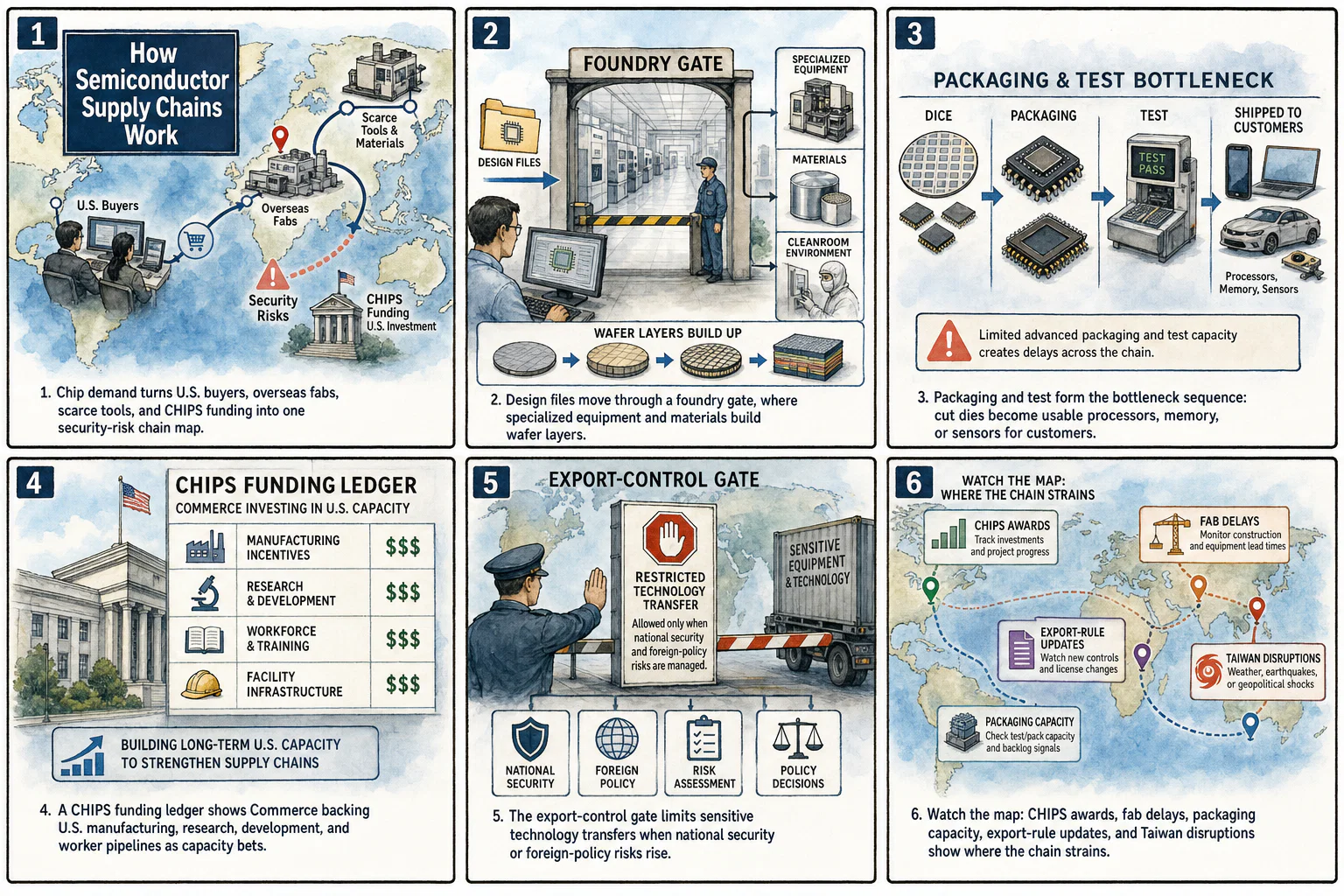
- Frame 1Chip demand turns U.S. buyers, overseas fabs, scarce tools, and CHIPS funding into one security-risk chain map.
- Frame 2Design files move through a foundry gate, where specialized equipment and materials build wafer layers.
- Frame 3Packaging and test form the bottleneck sequence: cut dies become usable processors, memory, or sensors for customers.
- Frame 4A CHIPS funding ledger shows Commerce backing U.S. manufacturing, research, development, and worker pipelines as capacity bets.
- Frame 5The export-control gate limits sensitive technology transfers when national security or foreign-policy risks rise.
- Frame 6Watch the map: CHIPS awards, fab delays, packaging capacity, export-rule updates, and Taiwan disruptions show where the chain strains.
How this was checked
- Reporting
- Cross-checked across 2 sources
- Claims
- We checked the names, dates, numbers, and core facts against the reporting linked above
- Artwork
- This is an editorial illustration based on the reporting, not source photography
- Published
- Jun 3, 12:10 PM EDT
- Our standards
- Editorial standards and corrections