Latest briefs Browse latest →
Redistricting, explained
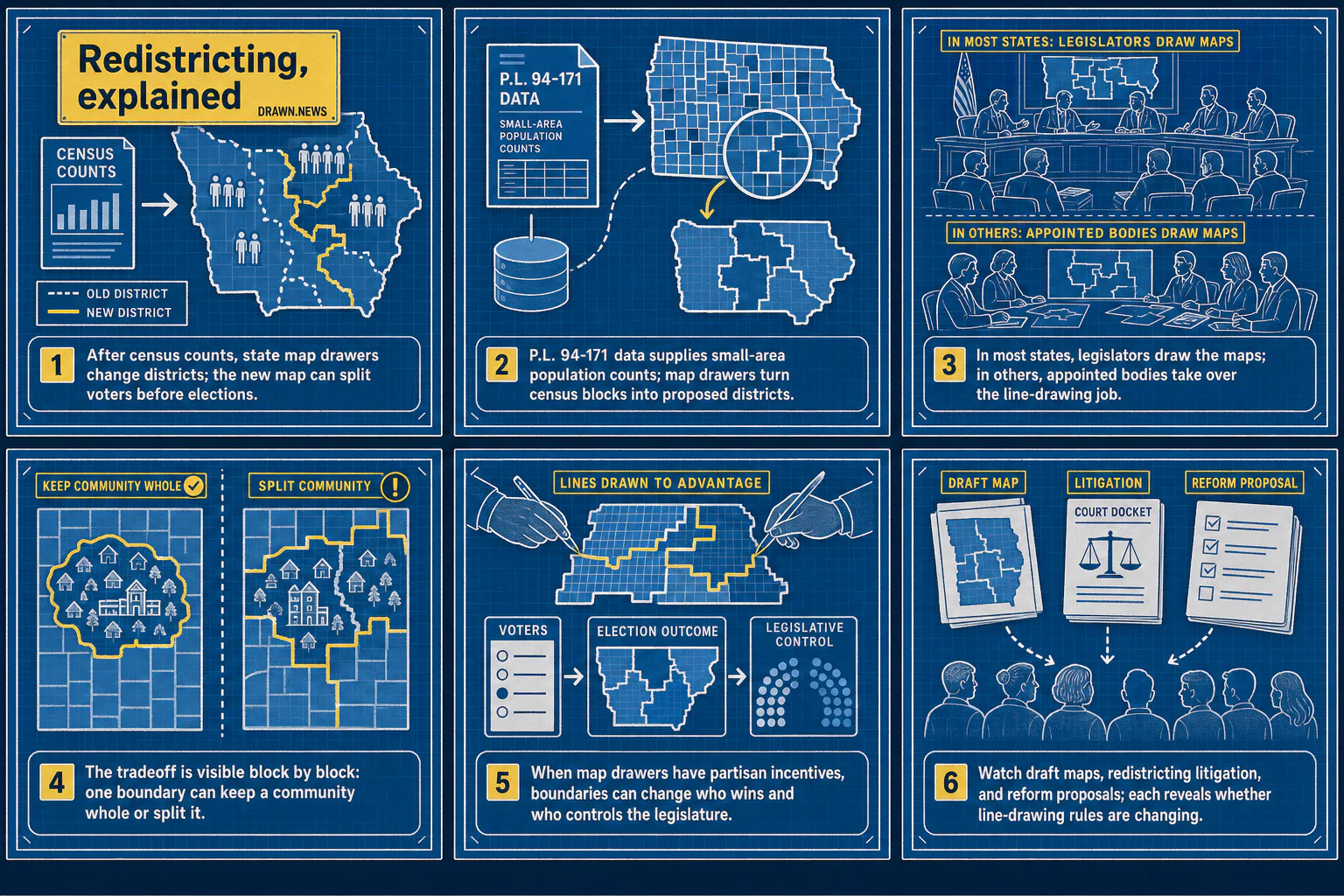
Redistricting redraws political district lines after population changes through census counts, map drawers, legal constraints, community boundaries, partisan incentives, and court review.
Full visual brief
Follow the story
Sources & verification
Sources behind this guide, checked before publication.
Brief text
Redistricting redraws political district lines after population changes through census counts, map drawers, legal constraints, community boundaries, partisan incentives, and court review.
- Frame 1After census counts, state map drawers change districts; the new map can split voters before elections.
- Frame 2P.L. 94-171 data supplies small-area population counts; map drawers turn census blocks into proposed districts.
- Frame 3In most states, legislators draw the maps; in others, appointed bodies take over the line-drawing job.
- Frame 4The tradeoff is visible block by block: one boundary can keep a community whole or split it.
- Frame 5When map drawers have partisan incentives, boundaries can change who wins and who controls the legislature.
- Frame 6Watch draft maps, redistricting litigation, and reform proposals; each reveals whether line-drawing rules are changing.
How this was checked
- Reporting
- Cross-checked across 2 sources
- Claims
- We checked the names, dates, numbers, and core facts against the reporting linked above
- Artwork
- This is an editorial illustration based on the reporting, not source photography
- Published
- Jun 4, 10:53 AM EDT
- Our standards
- Editorial standards and corrections