Latest briefs Browse latest →
How Quantum Computers Work
Quantum computers use qubits, superposition, entanglement, and error correction to solve some problems differently while leaving major engineering limits open.
Full visual brief
Follow the story
Sources & verification
Sources behind this guide, checked before publication.
Brief text
Quantum computers use qubits, superposition, entanglement, and error correction to solve some problems differently while leaving major engineering limits open.
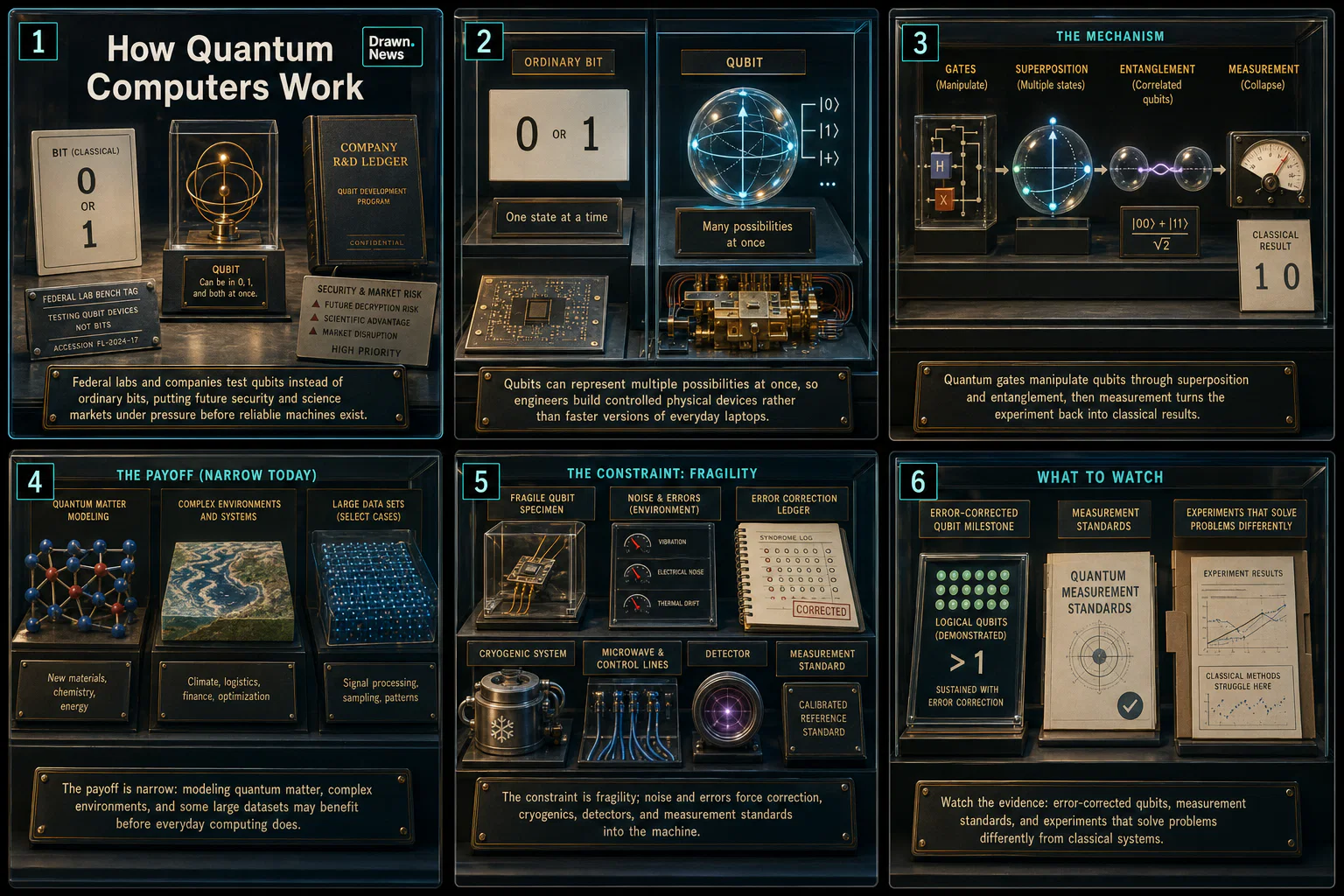
- Frame 1Federal labs and companies test qubits instead of ordinary bits, putting future security and science markets under pressure before reliable machines exist.
- Frame 2Qubits can represent multiple possibilities at once, so engineers build controlled physical devices rather than faster versions of everyday laptops.
- Frame 3Quantum gates manipulate qubits through superposition and entanglement, then measurement turns the experiment back into classical results.
- Frame 4The payoff is narrow: modeling quantum matter, complex environments, and some large datasets may benefit before everyday computing does.
- Frame 5The constraint is fragility; noise and errors force correction, cryogenics, detectors, and measurement standards into the machine.
- Frame 6Watch the evidence: error-corrected qubits, NIST measurement standards, and experiments that solve problems differently from classical systems.
How this was checked
- Reporting
- Cross-checked across 2 sources
- Claims
- We checked the names, dates, numbers, and core facts against the reporting linked above
- Artwork
- This is an editorial illustration based on the reporting, not source photography
- Published
- Jun 2, 12:12 PM EDT
- Our standards
- Editorial standards and corrections