Latest briefs Browse latest →
How Spacecraft Orbit Boosts Work
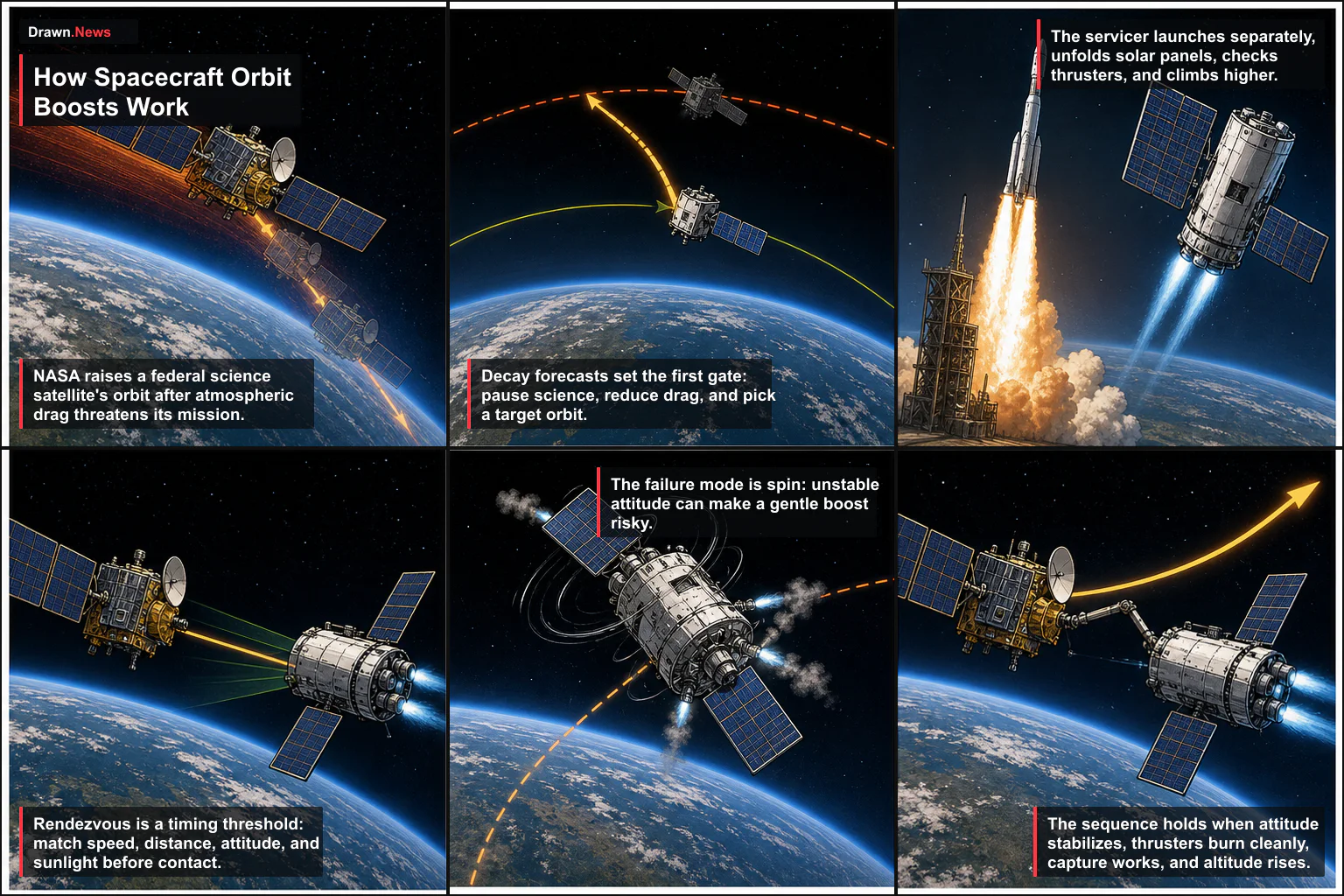
Spacecraft orbit boosts fight atmospheric drag by predicting decay, launching a servicing vehicle, matching orbit, stabilizing attitude, capturing or pushing gently, and raising altitude without damaging the mission.
Full visual brief
Follow the story
Sources & verification
Sources behind this guide, checked before publication.
Brief text
Spacecraft orbit boosts fight atmospheric drag by predicting decay, launching a servicing vehicle, matching orbit, stabilizing attitude, capturing or pushing gently, and raising altitude without damaging the mission.
- Frame 1NASA raises a federal science satellite's orbit after atmospheric drag threatens its mission.
- Frame 2Decay forecasts set the first gate: pause science, reduce drag, and pick a target orbit.
- Frame 3The servicer launches separately, unfolds solar panels, checks thrusters, and climbs higher.
- Frame 4Rendezvous is a timing threshold: match speed, distance, attitude, and sunlight before contact.
- Frame 5The failure mode is spin: unstable attitude can make a gentle boost risky.
- Frame 6The sequence holds when attitude stabilizes, thrusters burn cleanly, capture works, and altitude rises.
How this was checked
- Reporting
- Cross-checked across 3 sources
- Claims
- We checked the names, dates, numbers, and core facts against the reporting linked above
- Artwork
- This is an editorial illustration based on the reporting, not source photography
- Published
- Aug 8, 12:22 AM EDT
- Our standards
- Editorial standards and corrections