Latest briefs Browse latest →
Federal Race and Ethnicity Data, Explained
Federal race and ethnicity data turns self-identification, OMB standards, Census questions, detailed write-ins and agency tabulation rules into comparable statistics used for civil-rights enforcement, redistricting, program reporting and policy decisions.
Full visual brief
Follow the story
Sources & verification
Sources behind this guide, checked before publication.
Brief text
Federal race and ethnicity data turns self-identification, OMB standards, Census questions, detailed write-ins and agency tabulation rules into comparable statistics used for civil-rights enforcement, redistricting, program reporting and policy decisions.
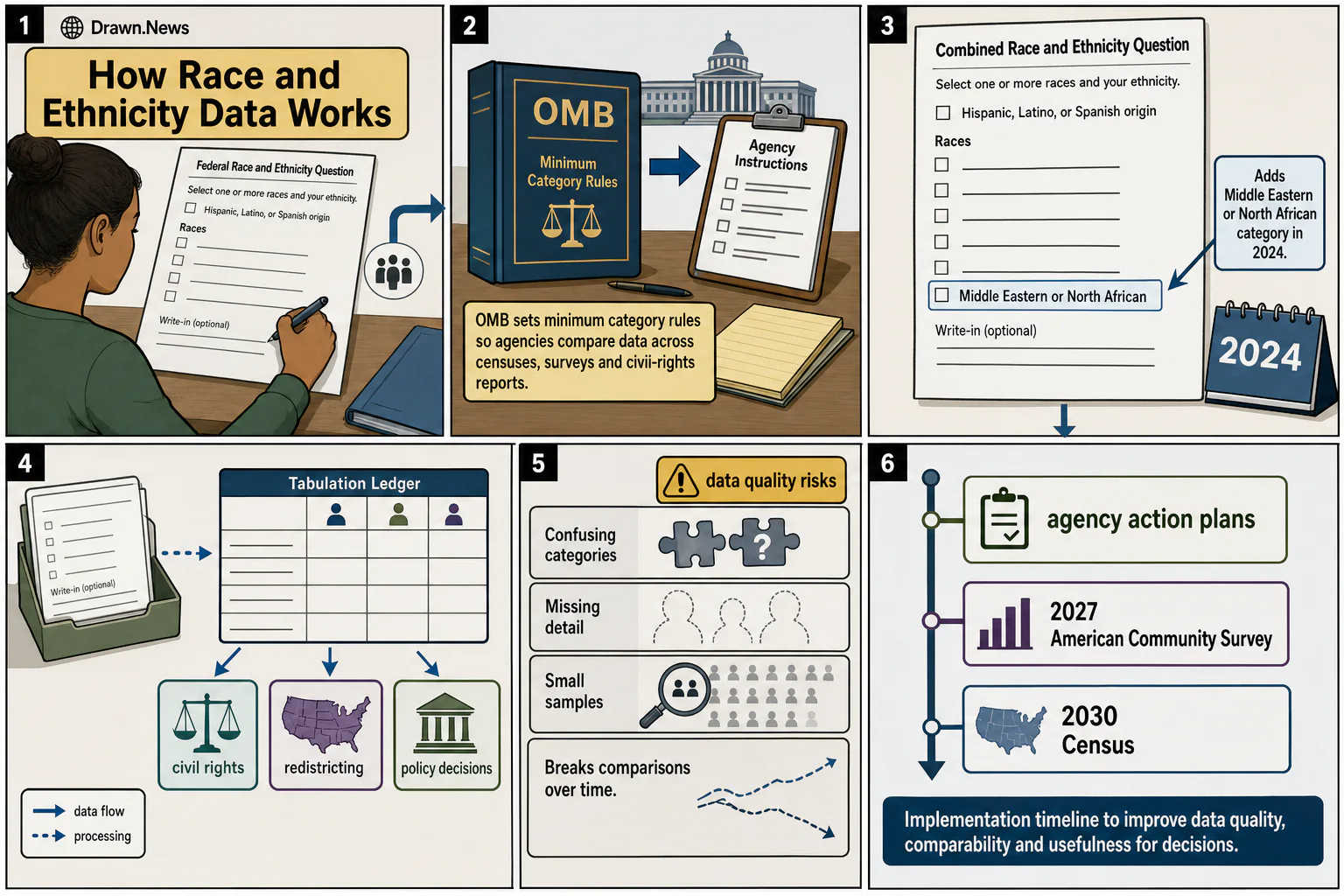
- Frame 1Federal race and ethnicity data turns self-identification into government rules for civil rights, redistricting, programs and policy decisions.
- Frame 2Input gate: OMB sets minimum category rules so agencies compare data across censuses, surveys and civil-rights reports.
- Frame 3Data path: the combined question allows multiple selections and adds the Middle Eastern or North African category in 2024.
- Frame 4Tabulation ledger: Census forms convert checkboxes and write-ins into grouped tables for policy decisions, redistricting and civil rights.
- Frame 5Failure mode: confusing categories, missing detail or small samples can hide communities or break comparisons over time.
- Frame 6Watch timeline: agency action plans, the 2027 American Community Survey and the 2030 Census show implementation.
How this was checked
- Reporting
- Cross-checked across 3 sources
- Claims
- We checked the names, dates, numbers, and core facts against the reporting linked above
- Artwork
- This is an editorial illustration based on the reporting, not source photography
- Published
- Jul 9, 5:59 PM EDT
- Our standards
- Editorial standards and corrections